
Maurice Müller
Senior Content Manager
Maurice Müller es periodista y estratega de contenidos, con experiencia tanto en medios impresos como digitales. En Formalize, convierte temas complejos de cumplimiento y regulación en contenido claro y práctico para profesionales de cumplimiento, riesgo y seguridad de toda Europa.
Conclusiones clave:
El "Software de GRC" abarca tres tipos diferentes de producto: plataformas de gestión de riesgos empresariales, sistemas orientados a la auditoría y herramientas de automatización del cumplimiento normativo. Decide cuál necesitas antes de comparar proveedores.
Tu carga de trabajo principal debería guiar la elección: riesgo empresarial, auditoría interna, varios marcos a la vez, certificación de seguridad o supervisión de proveedores.
Los seis proveedores de esta comparación fijan el precio bajo petición, así que las preguntas sobre licencias corresponden a la primera demo, no a la última.
Pide a cada proveedor que muestre tu propio flujo de trabajo antes de cualquier configuración personalizada, y que explique cómo exportarías tus datos y tu historial de auditoría si te fueras.
Si buscas “mejor software de GRC”, encontrarás listas que ponen en paralelo productos muy distintos. Algunos están pensados para gestionar el riesgo de un banco global con cientos de unidades de negocio. Otros se construyen en torno al plan de auditoría interna. Otros existen sobre todo para ayudar a una empresa SaaS a superar su primer informe SOC 2. Todos se venden como governanza, riesgo y cumplimiento (GRC), y compararlos con una única lista larga de funciones dice muy poco. Los profesionales que piden consejo suelen plantear las mismas dudas: cuánto tarda realmente la implementación, si las licencias siguen siendo predecibles a medida que crece el programa y si de verdad necesitan una plataforma de GRC específica. Esta comparación se ha construido en torno a esas preguntas.
Cómo hemos evaluado las plataformas de GRC
Elegimos seis plataformas que, entre todas, cubren los principales tipos de software de GRC: plataformas de riesgo empresarial (ServiceNow IRM y Archer), un sistema basado en la auditoría (Optro) y herramientas de cumplimiento, desde programas multimarco (Hyperproof) hasta la automatización de la seguridad (Vanta). Formalize conecta riesgos, cumplimiento y supervisión de proveedores en torno a marcos europeos.
Comparamos las plataformas en ocho dimensiones, a partir de lo que cada proveedor documenta en su propio sitio web:
Gestión de riesgos: métodos de evaluación, propiedad, tratamientos e informes.
Controles y cumplimiento: requisitos, políticas, pruebas de controles, evidencias y mapeo de marcos.
Auditoría interna: planificación, solicitudes, hallazgos y subsanación.
Riesgo de terceros: evaluaciones de proveedores, riesgos vinculados y revisiones continuas. Nuestra guía sobre gestión de riesgo de proveedores explica qué aspecto tiene una buena gestión.
Flujos de trabajo y responsabilidad: aprobaciones, notificaciones, historial y acceso basado en roles.
Informes: vistas que sirvan a los profesionales, a los directivos y al consejo.
Implementación: configuración, integraciones, migración y soportes.
Encaje comercial: se estructuran las licencias y qué módulos o servicios cuestan aparte.
Como referencia independiente, Gartner Peer Insights recoge para este mercado funciones como metodologías de evaluación de riesgos, interoperabilidad, visualización de datos e informes, y mapeo de marcos y controles. Lo usamos como contraste, no como modelo de puntuación.
Una nota sobre el método: esto es una comparación del encaje documentado de los productos, no una prueba práctica de cada plataforma. Formalize es nuestro propio producto, así que nos hemos ceñido a lo que cada proveedor publica sobre sí mismo, con una fuente y una fecha para cada plataforma. Las funciones cambian rápido, así que confirma en una demo todo lo que te importe y descubre cómo funciona nuestro sistema de GRC conectado.
Six GRC platforms compared
Quick picks by use case. These are editorial fits based on what each vendor publishes, not test results:
Risk, compliance and suppliers connected across European frameworks: Formalize
IT and security workflows already on ServiceNow: ServiceNow IRM
Complex enterprise risk programs: Archer
Programs led by internal audit: Optro
Compliance operations across many frameworks: Hyperproof
A first SOC 2 report or ISO 27001 certificate: Vanta
Platform | Best for | Primary strength | Risk, compliance and audit focus | Third-party oversight | Implementation support | Check in the demo |
|---|---|---|---|---|---|---|
Mid-market and regulated organizations working across European frameworks | Risks, controls, evidence, suppliers and approvals in one connected system | Mainly risk and multi-framework compliance; audit module for internal audits | Supplier assessments, contracts and evidence linked to risks | Guided setup with Compliance Blueprints, assisted migration of existing data | Integrations for evidence collection, if SOC 2 is the goal | |
Organizations already running on ServiceNow | Risk and compliance on the same platform as IT and security workflows | Mainly IT and operational risk; audit management available | Separate third-party risk management application | ServiceNow experts and implementation partners | Licensing and setup effort if you don't run ServiceNow yet | |
Large enterprises with complex risk programs | Enterprise risk across operational, IT and third-party risk | Mainly enterprise and regulatory risk; audit management available | Third-party governance product | Archer and implementation partners | Configuration effort and who maintains it after go-live | |
Optro (formerly AuditBoard) | Programs led by internal audit | Audit planning and workpapers connected to risk and compliance | Mainly internal audit and SOX-style controls | TPRM module | Optro Success and Services | Depth of risk and supplier workflows outside internal audit |
Multi-framework compliance and assurance programs | Shared controls across a large framework library | Mainly compliance and assurance; risk registers linked to controls | Vendor risk management module | Dedicated support team | Depth of enterprise risk and internal audit workflows | |
Startups and SaaS companies preparing for SOC 2 or ISO 27001 | Automated evidence collection through integrations | Mainly security compliance | Vendor discovery and risk assessment | Onboarding support; Vanta cites weeks rather than months | Risk, audit and governance depth beyond security compliance |
All six platforms are quote-based, and Formalize also offers a free plan and a 14-day trial. Vendor details checked on 22 October 2026 on each vendor's own website.
The leading GRC software platforms
Each profile below covers who the platform is best for and its key capabilities, based on the vendor's own website. Formalize gets a longer walkthrough further down, with screenshots, because it's the one product we can show from the inside.
Formalize: for connected risk, compliance and governance workflows
Best for: mid-market and regulated organizations, including financial entities, that manage several European frameworks such as NIS2, DORA, ISO 27001 and the GDPR, and need to show leadership how decisions were made.
Key capabilities: Formalize links every risk to the systems, suppliers, contracts, assets and business functions it affects, and scores it on your own matrix for inherent and residual risk. Governance tasks run as workflows with named owners and timestamped approvals. Supplier assessments, contracts and evidence sit next to the risks they introduce. Compliance Blueprints cover NIS2, DORA, ISO 27001, ISO 22301, the GDPR and more, and the Audit module runs internal audits structured to the IIA Global Internal Audit Standards. Formalize is hosted in the EU (AWS Frankfurt).
Source: formalize.com/en/grc
ServiceNow IRM: for organizations already running on ServiceNow
Best for: organizations that already run IT service management, security operations or other workflows on ServiceNow and want risk and compliance on the same platform.
Key capabilities: ServiceNow describes Integrated Risk Management (IRM) as connecting "risk and compliance across IT, cyber, and business operations in one system of action." It runs on the ServiceNow AI Platform. Audit management and policy and compliance management are offered within its GRC family, and a third-party risk management application covers the supplier lifecycle "from onboarding to retirement." For EU buyers, ServiceNow promotes DORA-aligned third-party risk management and reporting.
Source: servicenow.com: Integrated Risk Management
Archer: for complex enterprise risk programs
Best for: large enterprises, particularly in financial services, energy, healthcare and the public sector, where a central risk function runs several risk disciplines at once.
Key capabilities: Archer names the chief risk officer, chief compliance officer, head of internal audit and CISO as the roles it serves, and says more than 1,500 organizations run on it. Its Archer Evolv portfolio covers operational, IT, third-party and enterprise risk, with products for audit management, third-party governance, operational resilience and regulatory change. For regulatory change, Archer says it monitors more than 22 million regulatory sources and maps changes to controls.
Source: archerirm.com: Products
Optro: for audit-led GRC programs
Best for: organizations where internal audit drives the platform decision, including teams with SOX or extensive internal controls testing.
Key capabilities: Optro is the new name of AuditBoard, which rebranded in March 2026. Its audit capabilities include building "a risk-based plan across your audit universe," AI-drafted workpapers with cited evidence, and board-ready reporting. CrossComply covers compliance with a library of more than 30 frameworks, including SOC 2, ISO 27001 and the GDPR, and a TPRM module turns high-risk vendor findings into remediation tasks. Optro says every AI-supported step needs a person to approve it.
Source: optro.ai: Platform
Hyperproof: for multi-framework compliance and assurance programs
Best for: compliance and assurance teams, from mid-market to enterprise, running several frameworks in parallel.
Key capabilities: Hyperproof says it supports more than 160 frameworks, including SOC 2, ISO 27001, DORA, NIS2 and the GDPR, and lets teams "standardize control operations across multiple frameworks to minimize redundancy." Control health data feeds into risk registers, and vendor risk management is part of the platform. Its AI features recommend control mappings and draft evidence requests, with human review.
Source: hyperproof.io: Product
Vanta: for security compliance automation
Best for: startups and growing SaaS companies whose first goal is a SOC 2 report or an ISO 27001 certification.
Key capabilities: Vanta's core is automated evidence collection. It says it "automates up to 90% of the evidence needed to prove compliance" through more than 400 integrations, with automated tests that monitor controls hourly. It lists more than 35 frameworks, including SOC 2, ISO 27001, the GDPR, NIS2 and DORA, and also covers vendor discovery and vendor risk assessment.
Source: vanta.com: Trust Management Platform
Vendor details checked on 22 October 2026 on each vendor's own website. For the questions worth asking every vendor, see the demo checklist below.
Which GRC platform fits your organization?
Startups and growing SaaS companies
If a customer is asking for a SOC 2 report this quarter, evidence automation is the priority, and a tool built for that is usually the fastest route. Not every startup needs an enterprise GRC suite. The picture changes as you grow. Once you hold ISO 27001, sell to regulated customers or face NIS2 obligations, you need risks, policies and management decisions that connect to your controls, not just passing tests. Plan for that step when you choose, so you don't have to migrate a year later. Formalize supports SOC 2 and ISO 27001 alongside its European frameworks.
Mid-market teams managing several frameworks
When you run SOC 2 and ISO 27001, or ISO 27001, NIS2 and the GDPR at the same time, the main risk is doing the same work twice. Look for controls, evidence and owners managed once, in one system, with each framework showing its own view of them. Take incident handling: the procedure, owner and incident log you keep for ISO 27001 are also the starting point for NIS2, and you add what NIS2 asks for on top, such as significance criteria and the 24-hour early warning. Our ISO 27001 to NIS2 gap analysis shows where else that applies. Check framework depth, not just the logo list: a framework library can mean a full set of requirements with guidance, or a list of headings. Supplier oversight belongs in the same place, because most frameworks now ask how you manage third-party risk.
Large enterprises with complex risk and audit programs
Enterprises need a platform that mirrors their structure: legal entities, business units and regions, each with its own owners, and reporting that rolls up to group level. Ask how the platform handles your risk methodology, including scoring models and appetite, and how internal audit uses the same risk data rather than its own copy. Configuration is where these projects succeed or stall. Ask who will maintain the platform after go-live, and how much of that work your own team can do. See how Formalize approaches enterprise risk with Risk Intelligence.
Teams whose primary need is vendor risk or internal audit
Sometimes one workflow matters more than everything else. If supplier assessments dominate your workload, for example ICT third-party risk under DORA, weigh the vendor risk workflow most heavily: onboarding, questionnaires, contract data, monitoring and remediation. If the audit plan drives your year, an audit-led platform may suit you better than a broad GRC suite. Either way, check that the specialist workflow connects to your wider risk and control data, or you'll end up with a second spreadsheet.
¿Qué comprobar en una demo de software GRC?
Pide a cada proveedor que lo muestre con tu propio ejemplo, no con un guion preparado:
¿Cuánto de nuestro flujo de trabajo funciona antes de cualquier configuración personalizada?
¿Se pueden migrar nuestros controles, evidencias e historial existentes, y quién hace ese trabajo?
¿Cómo protegen los permisos el material sensible de riesgos, incidentes y auditoría?
¿Qué integraciones están incluidas y cuáles cuestan aparte?
¿Cómo se fija el precio de los usuarios, marcos, entidades, proveedores o módulos adicionales?
¿Podemos exportar todos nuestros datos, incluido el historial de auditoría, si nos vamos?
¿Dónde ayuda la IA, y qué decisiones siguen necesitando la aprobación de una persona?
Para comparar en igualdad de condiciones, da a todos los proveedores el mismo escenario. Por ejemplo: un nuevo proveedor crítico recibe una puntuación de riesgo alta. Pide a cada proveedor que lo lleve desde la evaluación del proveedor hasta una decisión de tratamiento aprobada, y que termine con la vista que vería tu dirección, incluido quién aprobó qué y cuándo.
Descubre Formalize con tu propio caso de uso
Trae un riesgo, un marco o un proveedor con el que estés trabajando. Te mostraremos cómo funciona en Formalize, desde la primera evaluación hasta el informe para tu dirección.

See how Formalize connects risk, controls and evidence
It starts with a risk assessment: the risk is scored on your own matrix, with inherent and residual values, and linked to the suppliers, systems and business functions it affects. It gets a named owner.
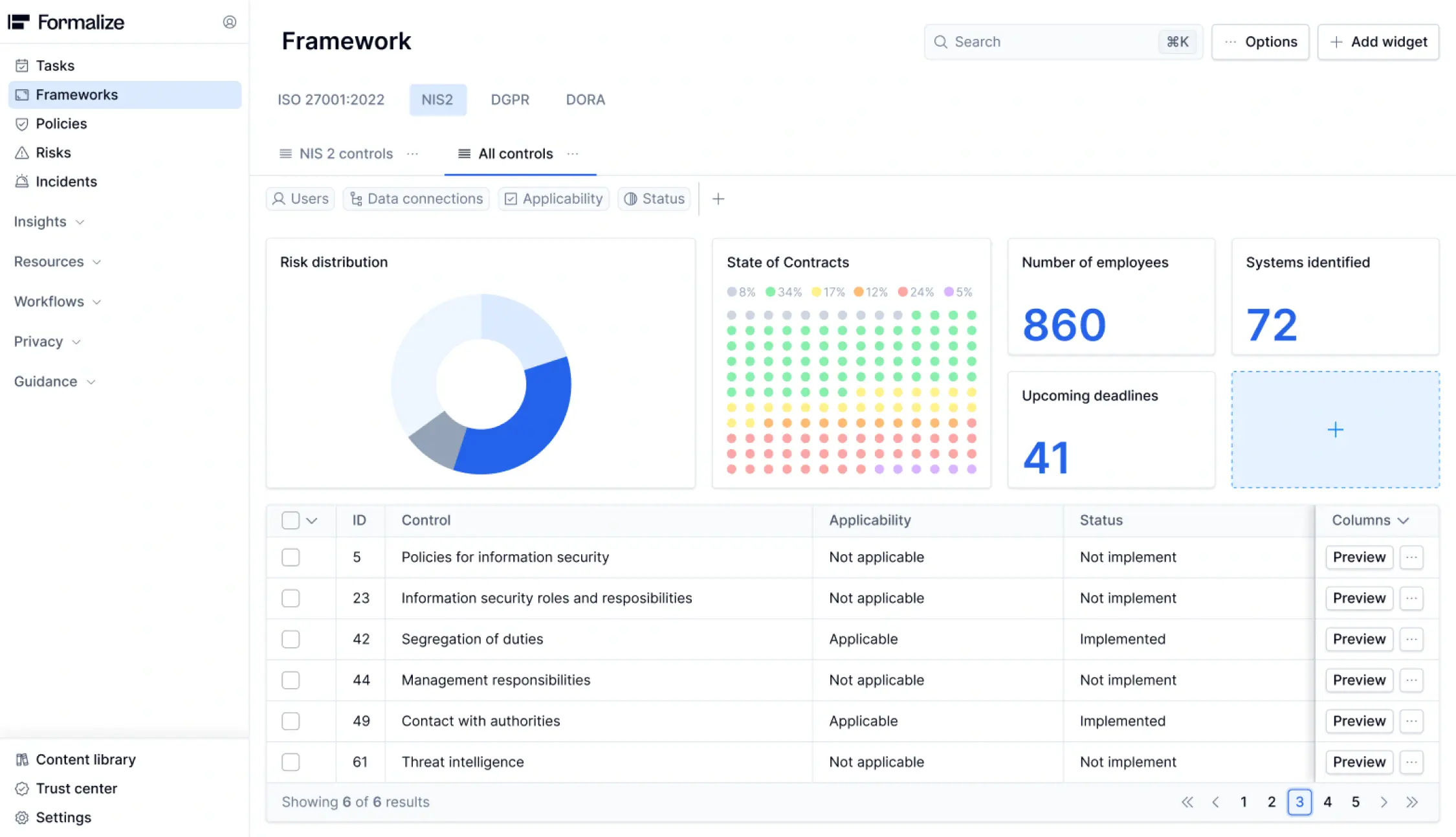 The owner links it to a control, mapped through framework and control management to the requirements it supports. Evidence is uploaded against the control, and the decision to accept or treat the risk goes through an approval workflow, timestamped and attributed. The status then shows up on the dashboard leadership reviews, with the approval trail behind it.
With Formalize, we went live practically on day one. Within two months, we had full coverage of our compliance needs, even over the holiday season.
Fernando Sanz de Galdeano, CISO, Arcano Partners
If you want to see that sequence with your own risks and frameworks, explore the Formalize GRC platform or book a walkthrough.