
Maurice Müller
Senior Content Manager
Maurice Müller is a journalist and content strategist with experience across print and digital media. At Formalize, he translates complex compliance and regulatory topics into clear, practical content for compliance, risk, and security professionals across Europe.
Key takeaways:
AI risk management identifies, assesses, mitigates, and monitors risks specific to AI systems, alongside an organization's broader risk management work.
Risks fall into a few recurring categories: data and privacy, model performance, bias and accountability, and security, operational, and compliance risk.
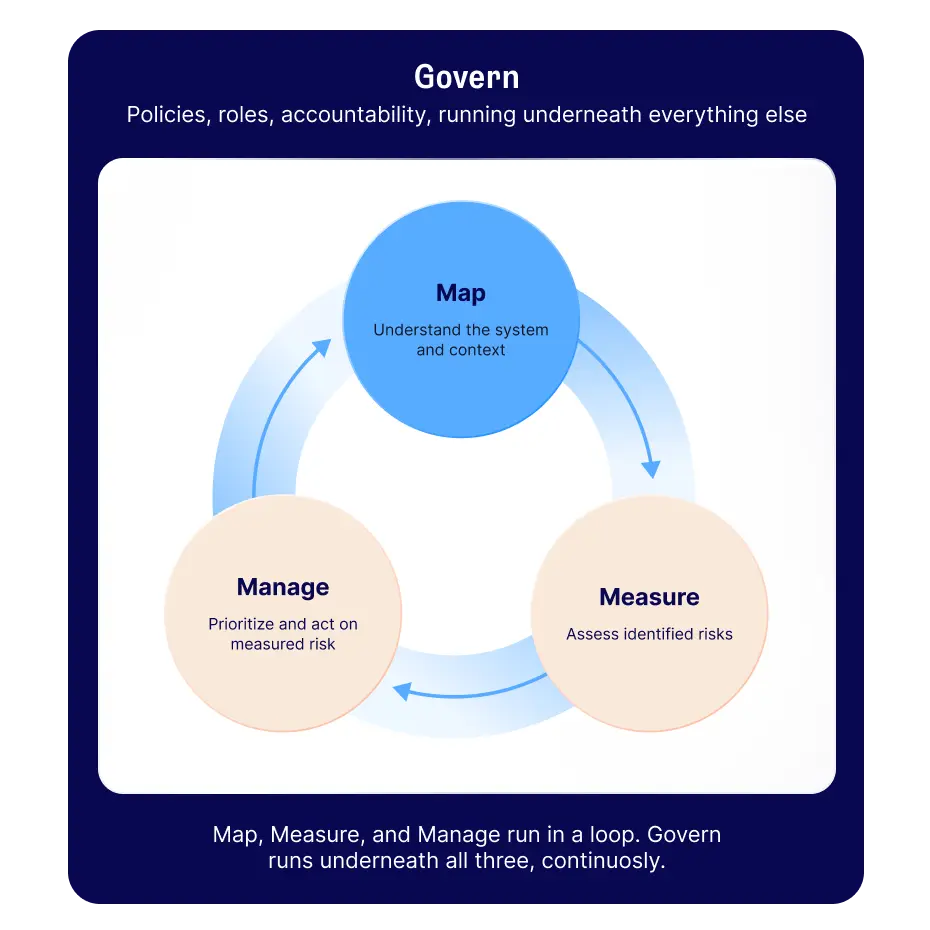
The NIST AI Risk Management Framework organizes this work into four functions: Govern, Map, Measure, and Manage.
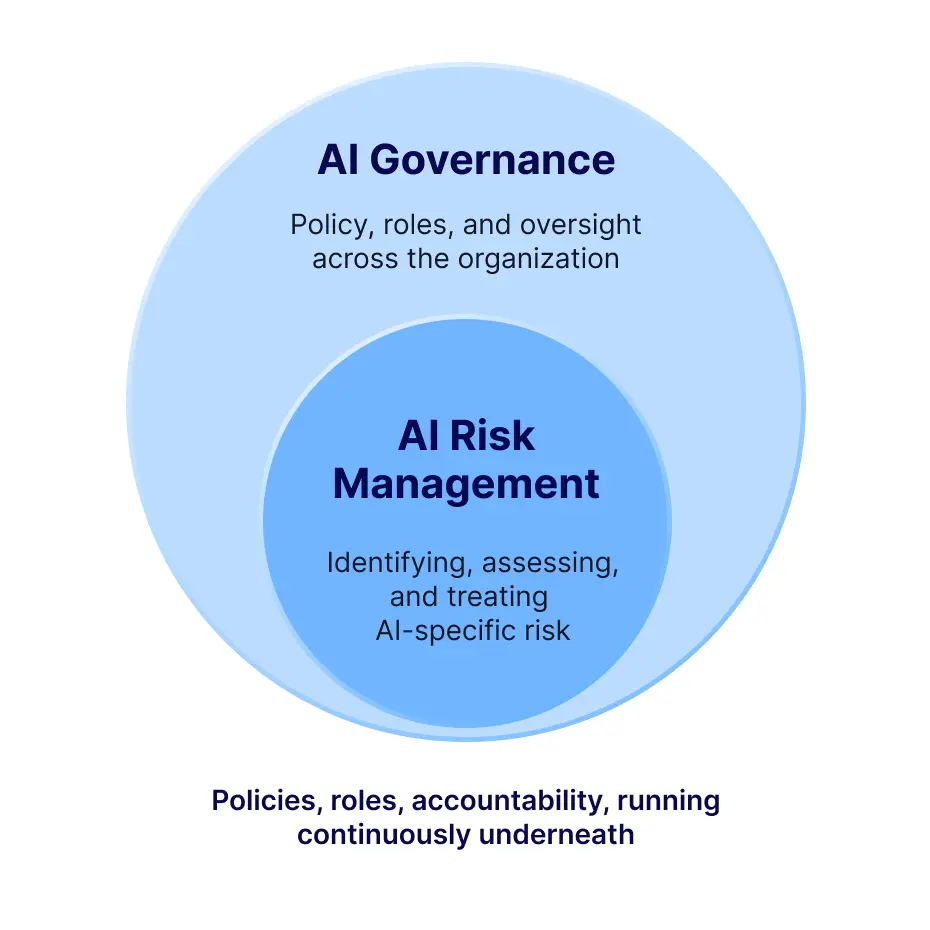
AI risk management is not the same as AI governance. Governance is the broader system of policy and oversight; risk management is the specific work of finding and treating AI risks inside it.
Software can connect AI systems to their risks, owners, and controls in one place, but it doesn't decide whether a given AI system is safe. That judgment stays with the organization.
Most organizations already manage risk in some form. AI adds a layer that general risk processes weren't built for: models that behave differently after deployment than they did in testing, and outputs that are hard to fully explain even to the people who built them.
Why is AI risk management important?
An AI system that fails doesn't fail quietly. A biased hiring model can affect real candidates before anyone notices the pattern. A customer-facing chatbot can give confidently wrong answers. A model trained on the wrong data can expose information it was never supposed to touch.
This isn't a hypothetical concern. Reported AI-related incidents rose to 233 in 2024, a 56.4% increase over the year before, according to Stanford's 2025 AI Index Report, which draws on the AI Incident Database. The same report found that while most organizations can name their key AI risks, fewer are actually taking steps to address them.
AI risk management exists to catch these before they become incidents, not after. That matters for a few reasons at once: the people an AI system affects, the compliance obligations an organization already carries, the reputational cost of a public failure, and the quality of decisions that increasingly lean on AI output.
It's worth being direct about the framing here: risk management isn't there to slow AI adoption down. Done well, it's what lets an organization adopt AI with a clear view of where the trade-offs are, instead of finding out the hard way.
What are the main types of AI risks?
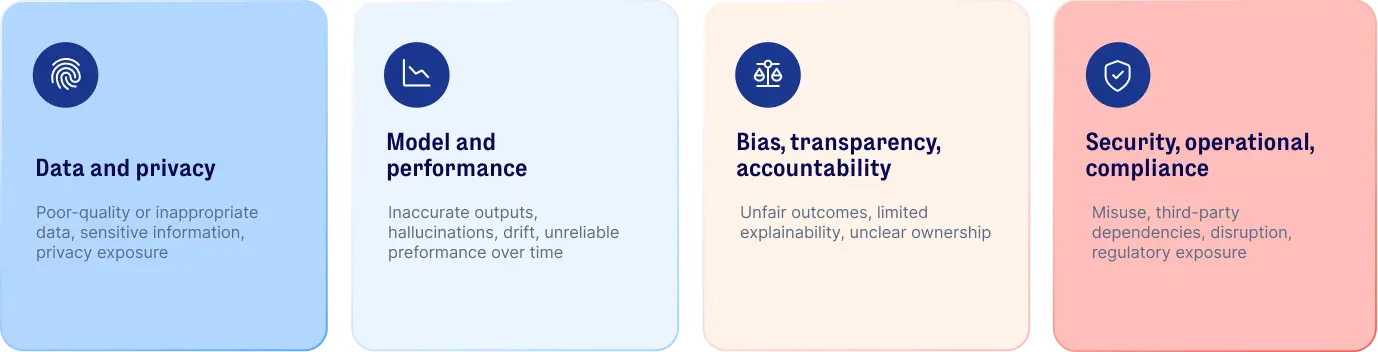
AI risk generally falls into four categories: data and privacy, model and performance, bias and accountability, and security, operational, and compliance risk.
 Data and privacy risks
AI systems are only as good as the training data behind them. Poor-quality, incomplete, or inappropriate training data produces unreliable outputs. Separately, AI systems that process personal data or other sensitive information raise the same privacy questions as any other system that touches that data, usually at greater scale, and can create a risk of data leakage if that information later surfaces in a model's output.
Model and performance risks
Outputs can be inaccurate. Generative models can produce confident, plausible answers that are simply wrong, a failure mode often called AI hallucination. Performance can also drift over time as the data a model sees in production diverges from what it was trained on, so a model that tested well can become less reliable months later without anyone changing anything.
Bias, transparency, and accountability risks
A model can produce unfair outcomes across different groups, sometimes without an obvious cause. Many AI systems, particularly complex ones, are hard to fully explain, which makes it difficult to say exactly why a specific output happened. That, in turn, makes it harder to say who's accountable when it happened badly.
Security, operational, and compliance risks
AI systems can be misused, manipulated, or depended on in ways that create a single point of failure. Many organizations rely on third-party models and APIs, which adds a dependency most teams don't fully control. On top of that, using AI can trigger obligations under the EU AI Act or other applicable regulation, obligations that exist regardless of whether an organization has actually mapped them yet.
What is the NIST AI Risk Management Framework?
The NIST AI Risk Management Framework (AI RMF) is voluntary guidance published by the US National Institute of Standards and Technology in January 2023. It gives organizations a structured way to manage AI risk across the lifecycle of a system, from design through deployment and eventual retirement. It isn't certifiable. There's no audit that ends with an "AI RMF certified" badge. What it gives organizations instead is a shared structure and vocabulary for the work.
The framework organizes that work into four functions.
 Govern AI risks
Set the policies, roles, and accountability that the other three functions depend on. This includes maintaining an inventory of AI systems with a named owner for each one. Govern isn't a step that happens once at the start. It runs underneath the other three the whole time.
Map AI risks
Understand the AI system itself: what it does, who it affects, and in what context it operates. This is where an organization identifies the risks that are actually relevant to a specific system, rather than working from a generic checklist.
Measure AI risks
Assess the risks that Map identified, using whatever mix of quantitative and qualitative methods actually fits the risk in question. Not every AI risk can be reduced to a single number, and the framework doesn't pretend otherwise.
Manage AI risks
Prioritize the measured risks and act on them: mitigate, accept, transfer, or in some cases, decide not to deploy. This is also where ongoing monitoring lives, since a risk that was acceptable at launch doesn't necessarily stay that way.
AI risk management vs. AI governance
The two terms get used interchangeably often enough that the distinction is worth making explicit.
AI governance | AI risk management | |
|---|---|---|
Scope | The broader system of policy, roles, and oversight for AI across an organization | The specific work of identifying, assessing, and treating AI-related risks |
Answers | Who's allowed to build or use what, and under what rules | What could go wrong with this system, and what are we doing about it |
Relationship | Sets the structure risk management operates inside | One of governance's core activities, not a separate program |
In practice, AI risk management is what AI governance actually looks like at the level of a single system.
AI risk management process: 6 steps
A lot of general risk management methodology applies here unchanged. What's specific to AI is mostly at the start of the process, before a risk ever gets scored.
Build an inventory of AI systems and use cases. This includes systems built in-house and third-party tools with AI features, which are easy to miss if the inventory only looks for AI a team deliberately built.
Assign owners and responsibilities. Every AI system needs someone accountable for it, not just a team that happens to maintain it.
Identify the risks relevant to each system. A customer-facing model carries different risks than an internal drafting tool. Generic risk categories are a starting point, not the answer.
Assess and prioritize. Not every AI risk needs the same depth of scrutiny. A customer-facing model making decisions about people warrants more scrutiny than an internal tool drafting first-pass text. A risk management framework built for the rest of the organization can extend to cover AI, rather than running a separate process just for AI systems.
Define controls and mitigation actions. For AI specifically, this often means human review at defined checkpoints, output monitoring, or restrictions on what data a system can access, alongside whatever conventional controls already apply.
Monitor continuously. AI risk doesn't stay fixed after go-live the way a static software risk might. A model can drift as the data it sees in production changes, a use case can expand beyond what was originally assessed, or a new regulation can change what's required, often without anyone deciding it should.
How to conduct an AI risk assessment
An AI risk assessment is the Measure step from the NIST framework in practice: rating each identified risk on how likely it is to occur and how severe the consequences would be if it did. Likelihood is often harder to pin down for AI specifically than for a conventional software risk, since a model's behavior can shift after deployment in ways a static system's never would. Most assessments end up blending quantitative measures, such as tracking output accuracy against a benchmark, with qualitative judgment for risks like bias or limited explainability that don't reduce to a single number easily.
Other AI risk management frameworks and standards
NIST AI RMF isn't the only reference point.
ISO/IEC 42001 is a certifiable AI management system standard, published in 2023. An organization can be independently audited and certified against it, the way ISO 27001 works for information security.
ISO/IEC 23894 provides guidance specifically on AI risk management. It isn't certifiable, and it extends the broader ISO 31000 risk management approach to risks that are specific to AI.
The EU AI Act takes a different approach again: it's a regulation, not a voluntary framework, and it classifies AI systems by risk level with different obligations attached to each level.
These aren't competing choices so much as different layers. An organization might align its internal process with NIST AI RMF, pursue ISO/IEC 42001 certification for external assurance, and separately need to meet EU AI Act obligations regardless of which voluntary framework it follows. For a broader comparison of how frameworks like these relate to each other, see our guide to risk management frameworks.
AI risk management software: How Formalize supports the process
Formalize connects AI systems to the same risk and control infrastructure an organization already uses for its broader compliance program, rather than running AI risk as a separate exercise in a separate tool.
That includes an inventory of AI systems and use cases, with named ownership for each one. From there, risks get classified and scored, connected directly to the controls and mitigation actions meant to address them. Evidence and status stay attached to the risk itself, so a dashboard shows what's actually been done, not just what was planned, and monitoring becomes a continuous read of that same record rather than a separate exercise. Where an organization already runs NIS2, DORA, ISO 27001, or other frameworks in Formalize, AI risk sits inside that same environment instead of a parallel spreadsheet.
See your AI systems connected to real controls
Bring your own AI inventory, or the spreadsheet standing in for one. We'd rather show you how it connects than describe it.
One thing worth being direct about: Formalize doesn't determine whether a given AI system is safe, compliant, or acceptable to deploy. That judgment belongs to the people who understand the system and its context. What the platform does is make that judgment easier to reach, document, and revisit, rather than leaving it to memory or a document nobody updates.